
Buying your first home is exciting, but the decision to make an offer should never be based on emotion alone. In South Africa, the strongest buyers usually know three things before they fall in love with a property: what they can afford, what the banks are likely to approve, and what cash they need for once-off costs.
This guide walks you through seven practical steps to take before signing an Offer to Purchase. It is written for first-time buyers who want to move with confidence, avoid common delays and understand how the home loan journey works from the start.
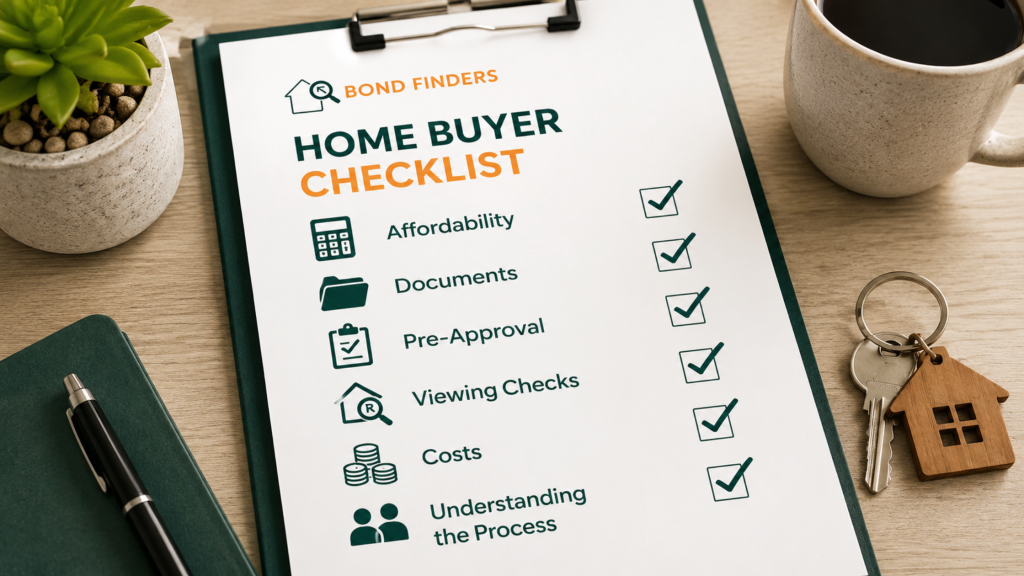
Step 1: Work out what you can comfortably afford
Start with your monthly budget, not the property price. A bond repayment is only one part of homeownership. You also need room for rates, levies if applicable, insurance, maintenance, utilities, moving costs and changes in interest rates.
A useful test is to calculate a repayment amount that still lets you save every month. Banks complete affordability checks before approving credit, but your personal comfort level matters too. A bond that is technically affordable can still feel stressful if it leaves no breathing room.
Step 2: Check your credit record before the bank does
Your credit record helps banks assess risk. Before house hunting seriously, review your credit report, settle missed payments where possible and avoid opening new short-term credit facilities. Keep your accounts stable and pay on time.
Do not panic if your score is not perfect. Rather, understand what is on the report and give yourself time to correct errors or improve your profile before submitting a home loan application.
Step 3: Prepare your documents early
Missing documents are one of the easiest ways to slow down a bond application. Employed buyers should usually prepare a copy of their ID, recent payslips, latest bank statements, proof of address and details of monthly expenses. Self-employed buyers may need more information, including financial statements, management accounts or tax-related documents.
Keep digital copies in one folder. Name them clearly so your bond consultant can check the application quickly and submit complete information to the banks.
Step 4: Get pre-approved before serious viewings
Pre-approval gives you a realistic price range before you start viewing properties. It is not a final bond grant, because the bank must still assess the actual property and final application, but it helps you avoid wasting time on homes outside your likely affordability range.
A pre-approval certificate can also help when speaking to estate agents and sellers because it shows that you are a prepared buyer.
Step 5: Understand your cash costs
Many first-time buyers focus on the deposit and forget about transaction costs. In South Africa, buyers may need cash for transfer costs, bond registration costs, transfer duty where applicable, attorney fees, bank initiation fees, occupational rent and moving expenses.
SARS confirms that transfer duty rates apply on a sliding scale, with the 2026/2027 rates effective from 1 April 2026 showing no changes from the previous year. Always ask for an updated cost estimate before making an offer, especially when buying near a tax threshold.
Step 6: Inspect the property with a checklist
At viewings, look beyond paint colour and furniture. Check water pressure, damp marks, cracks, roof condition, electrical points, boundary walls, security, parking, noise, cell reception and the condition of shared spaces in complexes.
Ask for available compliance certificates, levy statements, body corporate information, municipal account details and information about known defects. You can make an offer subject to conditions, but you should understand what you are committing to before you sign.
Step 7: Know what happens after your offer is accepted
Once the seller accepts your offer, the bond process begins in earnest. Your application is packaged, submitted to banks, assessed, valued and then either approved, declined or approved subject to conditions. The transfer process also begins with attorneys and the Deeds Office.
The Deeds Office describes property transfer as the process of registering or transferring the title deed into the buyer’s name. That means your homeownership journey is not complete when the bond is approved; it is complete when the property is registered.
How Bond Finders helps first-time buyers
Bond Finders helps buyers move from uncertainty to a clear home loan plan. The team works with South Africa’s leading banks, helps package your application, compares available offers and supports you through the process at no direct cost to the client.
For first-time buyers, that support is valuable because it turns a complicated process into a guided sequence: affordability, pre-qualification, application, bank comparison, approval and next steps.
First-time buyer checklist
Before making an offer, confirm your comfortable monthly repayment, check your credit report, gather your documents, get pre-approved, estimate all cash costs, inspect the property carefully and understand the timelines after acceptance.
Keep the checklist close during each viewing. A home can feel right emotionally, but the numbers and paperwork must also make sense.

Frequently Asked Questions
Do first-time buyers in South Africa always need a deposit?
Not always. Some banks may consider higher loan-to-value or even 100% home loan applications depending on the buyer’s profile, income, credit record and property. A deposit can still strengthen an application and reduce repayments.
Is pre-approval the same as final bond approval?
No. Pre-approval is an early affordability indication. Final approval depends on the full application, bank assessment, supporting documents and property valuation.
What costs should I budget for besides the purchase price?
Budget for transfer costs, bond registration costs, transfer duty if applicable, attorney fees, bank initiation fees, insurance, moving costs and possible occupational rent.
Can Bond Finders apply to more than one bank?
Yes. Bond Finders positions its bond origination service around submitting applications to multiple banks and helping buyers compare offers.
Ready to buy your first home with a clearer plan? Contact Bond Finders to check your affordability, prepare your documents and compare home loan options before you make an offer.